 348 24 34 266  info@arredalo.com |

|
|
|
go to another press releases |
FROM SHOPFRONTS TO RENOIR: THE SURPRISING HISTORY OF RED-AND-WHITE STRIPED AWNINGS
19 NOVEMBER 2026|
HISTORICAL RESEARCH & DESIGN | STRIPED AWNINGS AND SUNSHADES | ARREDALO From nineteenth-century fabric canopies to the Impressionists and the architecture of luxury hotels.
Red-and-white striped awnings are among the most distinctive features of classic European outdoor design. They appear on the façades of historic cafés, above restaurant terraces, on the balconies of period hotels and in contemporary architectural projects inspired by the aesthetics of the past. Today, this colour combination evokes the elegance of old Europe, French cafés, Italian terraces and the atmosphere of the Belle Époque. Alternating broad bands of red and white, sometimes softened into warmer shades of cream or ivory, create a striking visual rhythm. They draw the eye, emphasise the geometry of a structure and give a space an instantly recognisable character. It is hardly surprising, then, that architects and interior designers are rediscovering these fabrics for historic buildings, five-star hotels, restaurants and exclusive terraces. An awning is no longer simply protection from the sun: it becomes an integral element of the architectural design. But where did this fashion originate? Who first thought of using bold coloured stripes on outdoor coverings? And how did such a practical solution become a symbol of European elegance? The answer is more intriguing than one might expect. From everyday fabrics to sun awningsThe history of striped canopies has origins that are anything but romantic. Early fabric coverings were designed primarily to provide shelter from the sun and rain and to prevent interiors from overheating. They required sturdy, closely woven, relatively inexpensive materials capable of withstanding outdoor exposure. Various heavy-duty fabrics were used, including cotton canvas and sailcloth, made using techniques similar to those employed in the production of ships' sails and everyday protective coverings. Particularly interesting is the history of ticking, a striped fabric widely used in England. Thanks to its dense, durable weave, it was used for mattress covers, workwear and other items intended for prolonged use.
Stripes were a recurring feature of many such textiles. It is possible that early sunshades were sometimes made from remnants or repurposed household fabrics known for their durability. Such materials could have been especially valuable to less affluent families: old mattress covers, leftover sailcloth and other available scraps might have been used to shade windows and rooms or to create simple shelters outdoors. Nor can we rule out the possibility that these improvised coverings were found in working-class neighbourhoods, where affordability and practicality were essential considerations. This remains, however, a plausible reconstruction rather than a historically documented explanation for the origins of striped awnings. Manufacturers may subsequently have adopted this distinctive pattern and introduced it into the wider production of outdoor coverings. In some respects, the process recalls the history of fashion: what begins as a practical solution in everyday street life is often reinterpreted, becomes desirable and eventually enters the vocabulary of design. In this way, striped fabric may have made the transition from an ordinary household material to a defining element of urban architecture. When did awnings first appear on building façades?There is no universally recognised inventor of the façade awning. Its design evolved gradually from earlier fabric canopies used to protect shops, windows and entrances. In France, references to fabric coverings installed outside commercial premises can be traced back to the eighteenth century. In 1835, the Dictionnaire de l'Académie française described the banne as a type of covering that shopkeepers placed in front of their premises to protect them from the sun. This is significant evidence: by the first half of the nineteenth century, awnings had become a recognisable feature of the European urban landscape. For shopkeepers, they protected merchandise from direct sunlight and rain; for customers, they made browsing shop windows a more pleasant experience. These coverings were not necessarily striped, however. Both plain-coloured and patterned fabrics were used.
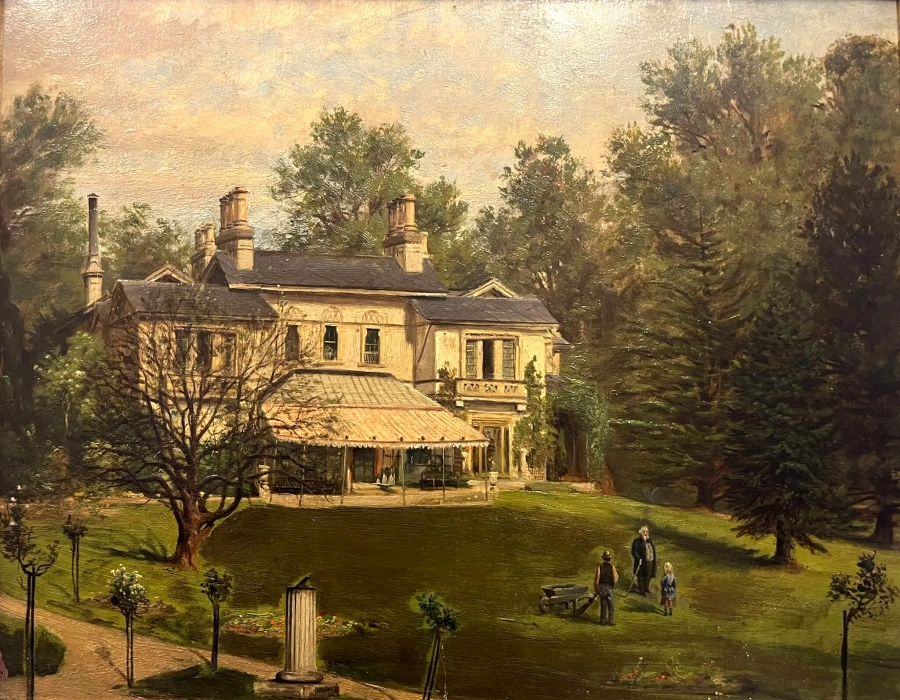
"Country House and Veranda with Figures", late nineteenth century, artist unidentified. Garden Museum collection, London. The painting depicts a veranda extended by a striped fabric canopy supported on poles.
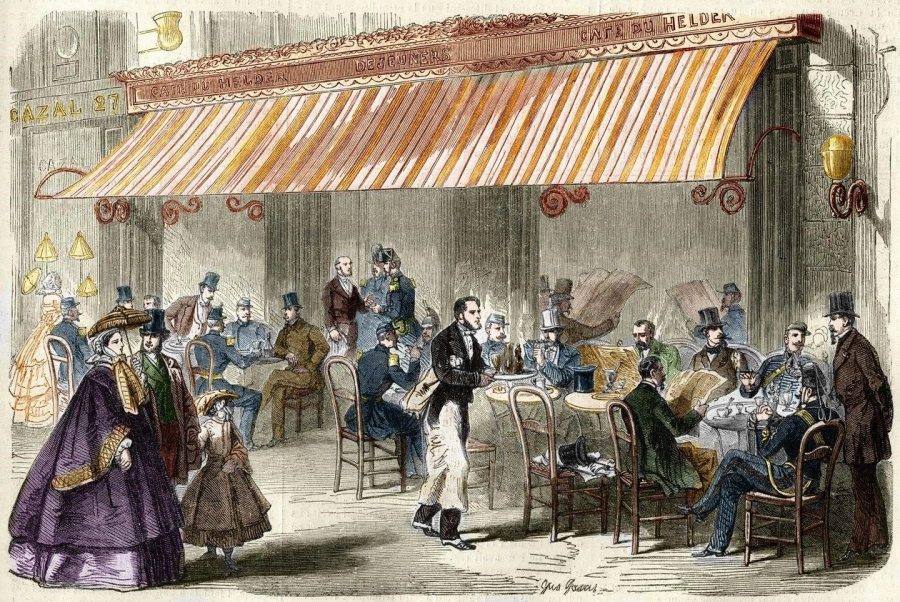
1840: striped sunshades on the façades of MadridOne of the most fascinating written accounts from the first half of the nineteenth century comes from the French writer Théophile Gautier. During his journey through Spain in 1840, Gautier was struck by the picturesque appearance of Madrid's houses. In his book Voyage en Espagne, published in 1843, he described windows shaded by fabrics with broad blue-and-white stripes, referring to them as stores à la vénitienne, or Venetian-style blinds and shades. This is an important detail: broad alternating stripes were already being used in façade shading during the first half of the nineteenth century. The constructions described by Gautier should not automatically be equated with modern retractable awnings. Nevertheless, the visual language of wide, contrasting stripes was already part of urban architecture. Striped textiles, therefore, were present in southern Europe well before they became associated with fashionable Parisian cafés and resort terraces. Mid-nineteenth century: the awning becomes a feature of the commercial streetscapeDuring the nineteenth century, awnings began to acquire architectural and commercial significance in addition to their practical purpose. Owners of cafés, restaurants and shops gradually realised that coloured fabric could distinguish their façades from neighbouring buildings. Alternating contrasting bands created a strong visual rhythm, made entrances more noticeable and helped establish the identity of a business. The awning thus became an extension of the façade and, in some cases, its principal decorative feature. A revealing example is the 1859 engraving depicting the Café du Helder on the Boulevard des Italiens in Paris.
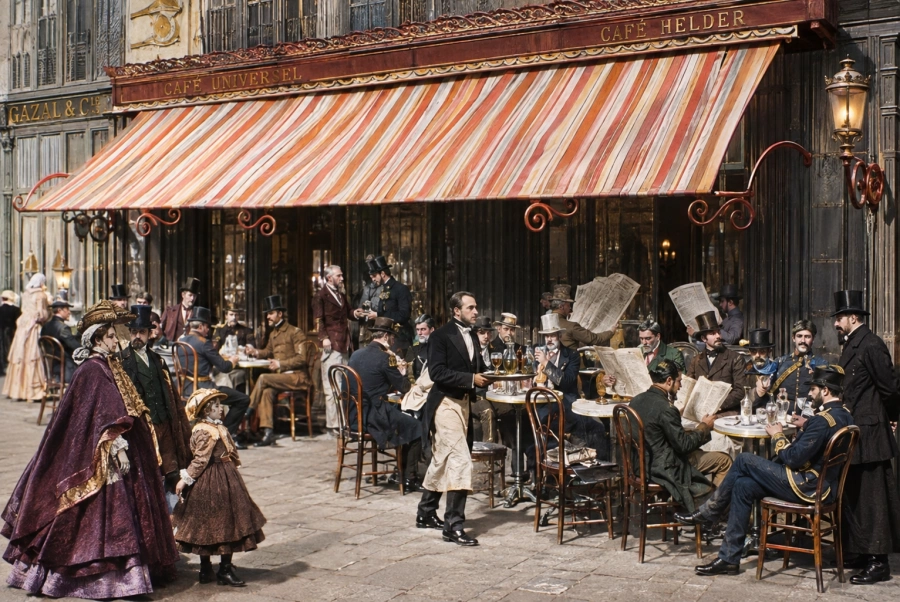
The Café du Helder on the Boulevard des Italiens, Paris. Period engraving, 1859: a large striped awning frames the life of the café and becomes part of its urban identity.
The scene captures the lively atmosphere of a Parisian café: people sit at tables, converse and read newspapers beneath a large striped awning. This is no longer merely an improvised shelter. The canopy has become part of the establishment's identity and the life of the street. It serves a dual purpose: protecting customers from the sun while making the commercial space more recognisable, inviting and distinctive. Such solutions would gradually become familiar sights throughout European cities. 1875: why did Larousse call a red-striped awning "Italian"?A particularly intriguing document appears in Pierre Larousse's Grand dictionnaire universel du XIXe siècle. The 1875 edition describes a structure known as a store à l'italienne, literally an "Italian-style awning". The author presents it as an elegant, decorative sunshade made from sturdy, natural-coloured canvas featuring fairly broad red stripes. He also describes its mechanical structure, including a roller, crank and guiding components that allow the fabric to be extended at a particular angle.
Pierre Larousse, Grand dictionnaire universel du XIXe siècle, volume XIV, 1875, entry "Store": description of the "store à l'italienne", featuring natural-coloured canvas with broad red stripes.
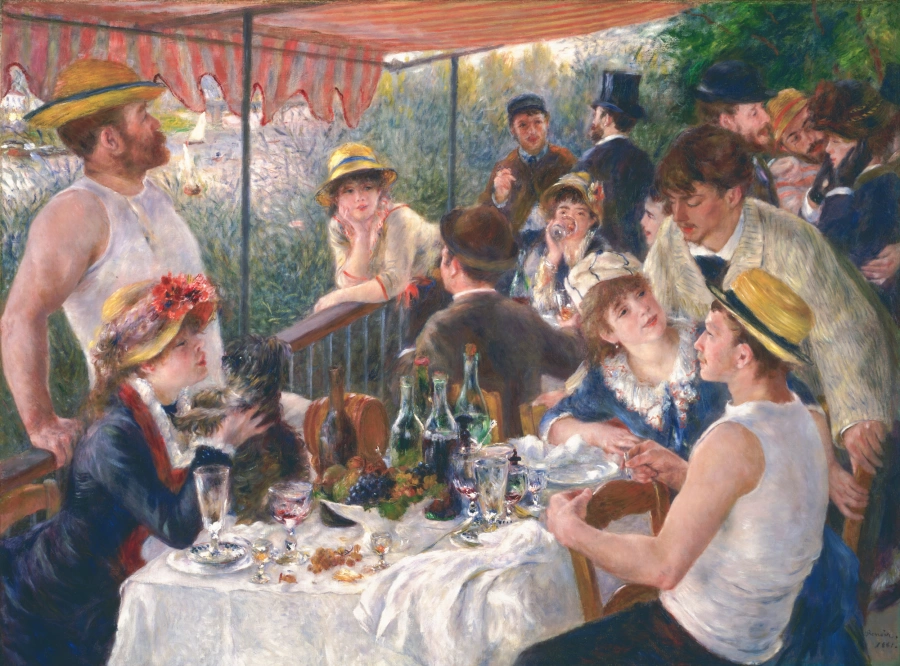
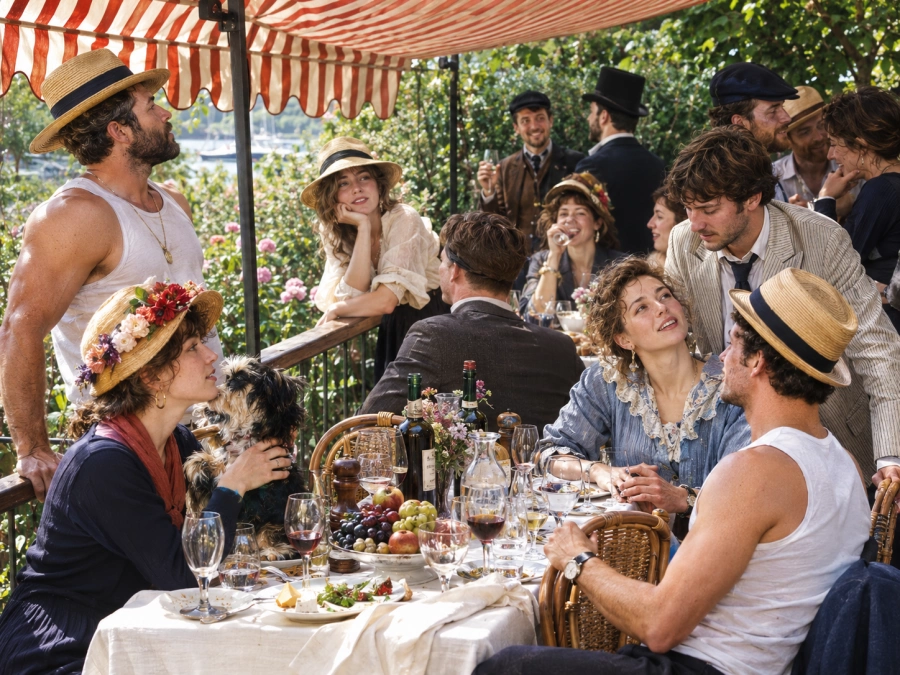
These coverings were used in southern Europe and, in France, chiefly to shade commercial façades. What is striking is that Larousse also emphasises their aesthetic appeal. Why, then, were they described as "Italian"? It is possible that, to French observers of the period, this form of sun protection evoked Italian cities, where the climate made fabric shading particularly useful. Nor can we exclude the possibility that Italian merchants played a part in popularising striped awnings on commercial façades. But this remains a hypothesis. The term store à l'italienne documents a historical association with Italy; it does not establish that Italians invented the striped awning. The essential point is this: by 1875, broad red stripes were already such a recognisable feature of a particular type of awning that they appeared in an encyclopaedic description. Red-and-white stripes enter the world of art: Renoir and the Belle ÉpoqueIn the second half of the nineteenth century, striped awnings moved beyond architecture and entered visual culture. They appeared in depictions of streets, cafés, restaurants and places where people gathered. The French Impressionists played an important role, seeking to capture modern life through natural light, movement, conversation and leisure in the open air. One of the most evocative examples is Le Déjeuner des canotiers (Luncheon of the Boating Party) by Pierre-Auguste Renoir, painted between 1880 and 1881.
Pierre-Auguste Renoir, "Le Déjeuner des canotiers" ("Luncheon of the Boating Party"), 1880–1881. Oil on canvas, 130.2 × 175.6 cm. The Phillips Collection, Washington, D.C. The red-and-light-striped awning structures the upper portion of the composition.
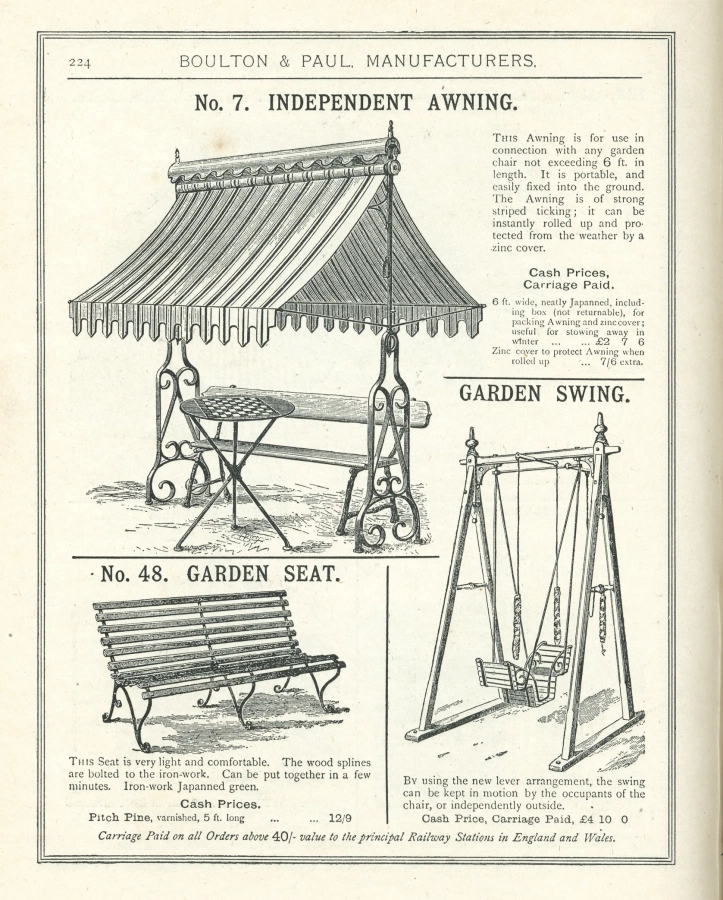
The artist depicts a group of friends on the terrace of the Maison Fournaise in Chatou, near Paris, on the banks of the Seine. Above the diners stretches a large awning with soft red and pale stripes. The fabric occupies a substantial part of the composition: it establishes a rhythm, frames the scene and interacts with the daylight. It is particularly fascinating that modern studies of the painting have revealed that Renoir added the awning during the creative process, altering the original composition. The striped canopy is therefore far from an insignificant background detail: it becomes an essential element of the painter's composition. Beneath those stripes, conversation, gestures, reflections of light and the atmosphere of a day spent together are brought into harmony. Images such as this helped establish the enduring appeal of late-nineteenth-century European cafés in the collective imagination. Over time, red-and-white or red-and-cream awnings would become increasingly associated with the Belle Époque: a world of elegant cafés, bustling boulevards, artistic salons and new forms of social life. Renoir, of course, did not invent the striped awning. His art did, however, help transform that image into a recognisable part of Europe's artistic heritage. 1895: from decorative motif to industrial productionBy the end of the nineteenth century, the manufacture of shading systems had become an industry in its own right. Manufacturers offered frames in various shapes, opening mechanisms, bespoke dimensions, fabrics and a wide range of colour combinations. Historical catalogues show that striped coverings were no longer unusual. In the collection of Britain's Garden Museum, for example, there is an advertisement dating from 1895 by Boulton & Paul Manufacturers, featuring a garden awning made from sturdy striped fabric.
"Advertisement for Boulton & Paul Manufacturers", 1895. Advertisement for the "No. 7 Independent Awning", made from durable striped fabric. Garden Museum collection, London. The structure allowed the covering to be rolled away and protected from bad weather. It is evidence of an established market in which striped fabrics had become part of the commercial product range. A similar development took place in the United States. Historical photographs of American shopping streets reveal the growing use of façade awnings, often embellished with stripes, decorative valances, shop names and painted lettering. The awning now performed several functions at once: providing shade, decorating the façade and giving a business a recognisable visual identity. Out of different local traditions emerged an architectural language that could be recognised on both sides of the Atlantic. From 1905 to the 1930s: stripes become a garden classicThe popularity of striped designs did not end with the nineteenth century. Small garden awnings and sun shelters remained in use well into the new century, becoming familiar features of outdoor leisure.
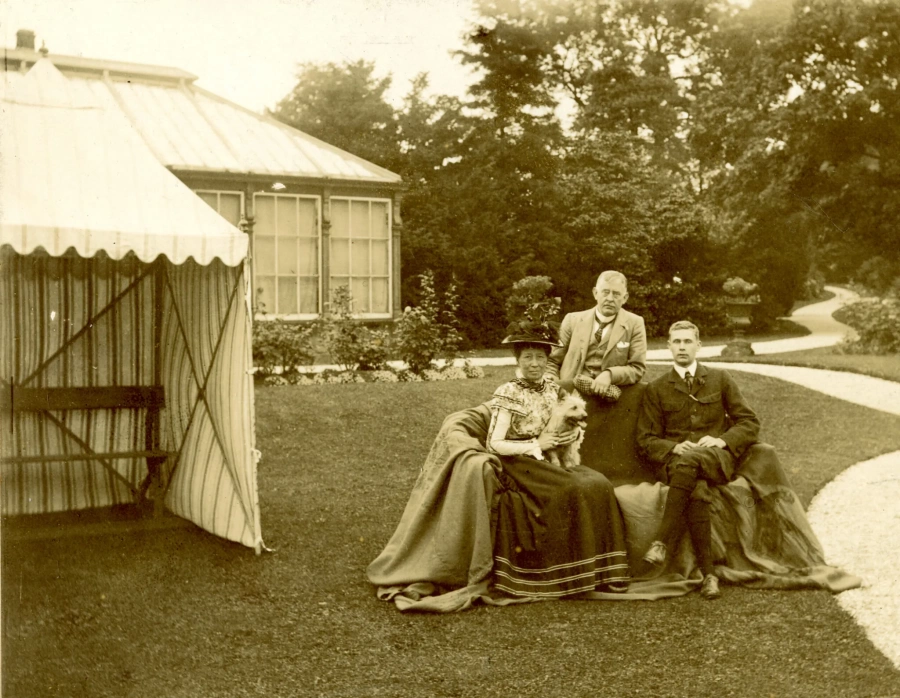
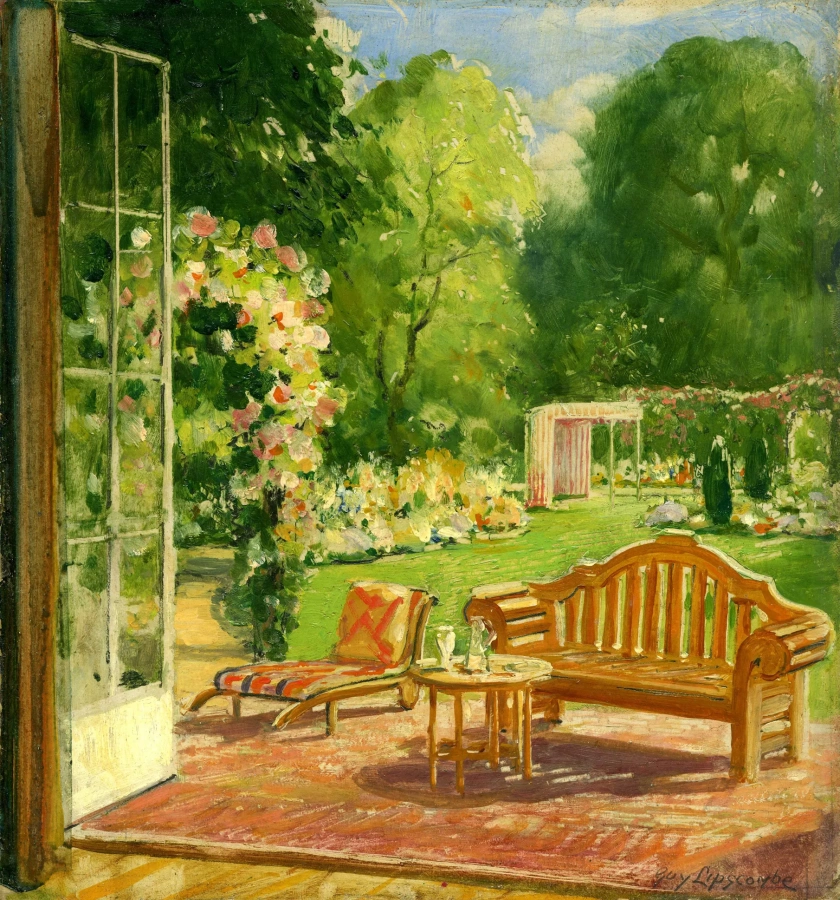
"A striped garden awning", c. 1905. Photograph of Captain Webb and his family beside a small garden awning with a metal frame and striped fabric. Garden Museum collection, London. Another illustration of the transition from practical shelter to tasteful decoration can be found in twentieth-century painting, where the striped awning appears as part of an elegant, carefully arranged setting devoted to leisure.
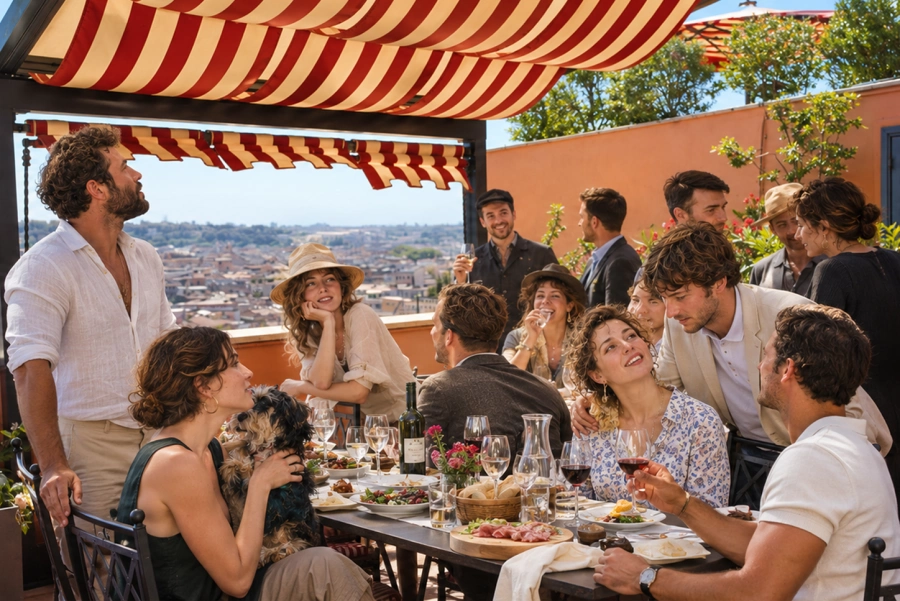
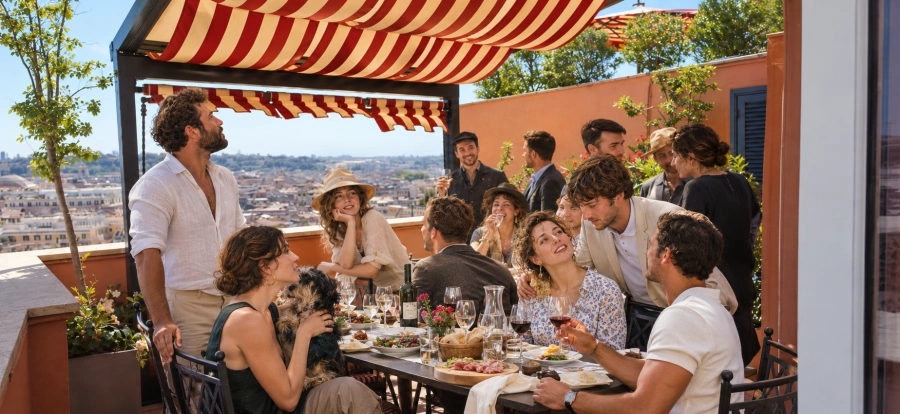
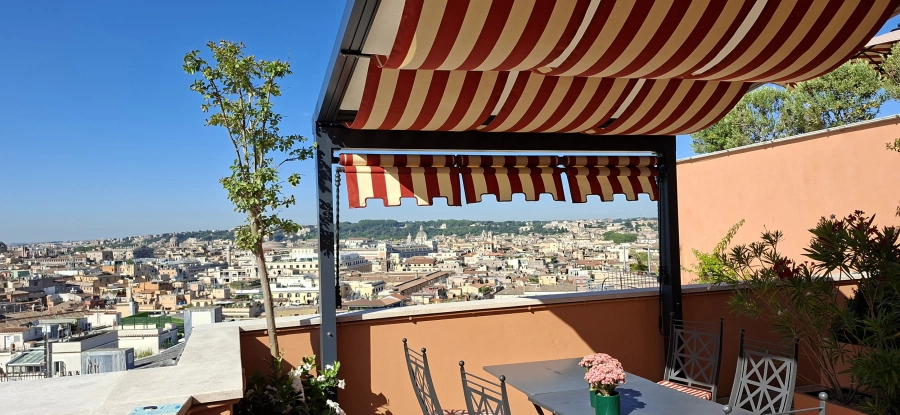
Guy Lipscombe, "A Garden in Summer", 1930. Garden Museum collection, London. The painting depicts a garden with a bench, a reclining chair, a small table and a striped canopy in the background. Why does striped design still appeal today?Today, broad red-and-white striped awnings are perceived very differently from when they first became widespread. Once a practical and affordable way to protect against the sun, this pattern is now often chosen deliberately to evoke a particular historical atmosphere. For architects and designers, striped fabric is a reference to retro style, classical European architecture and the aesthetics of the Belle Époque. The interplay of rich red and warm, cream-toned white lends personality to a space, creates a welcoming atmosphere and reinforces its relationship with its historical surroundings. In contemporary projects, such coverings are particularly expressive when paired with dark metal frameworks, traditional furnishings, natural materials and classical architectural details. Unlike a neutral, plain-coloured canopy, a striped awning becomes a design statement in its own right. That is why it continues to be chosen for historic hotels, exclusive restaurants, terraces and high-end settings where preserving the character of a building matters as much as providing contemporary comfort. Historical aesthetics in a contemporary project: Hotel de la Ville in RomeAn interesting example of this reinterpretation is the project created for the Rocco Forte Hotel de la Ville, a five-star luxury hotel in Rome's historic centre. The design concept is associated with the work of the London-based Paolo Moschino studio and architect Stefano Albanese. The composition of the terraces reflects aesthetic references to European sunshades of the second half of the nineteenth century. Broad red-and-cream stripes evoke French cafés, period engravings and Impressionist painting. There is a visual affinity with Renoir's work and the atmosphere of the Belle Époque: a contemporary reinterpretation rather than a literal reproduction of a historic structure. The challenge was to create sunshades that would sit naturally within the architecture of historic Rome while meeting the practical needs of a contemporary hotel terrace.
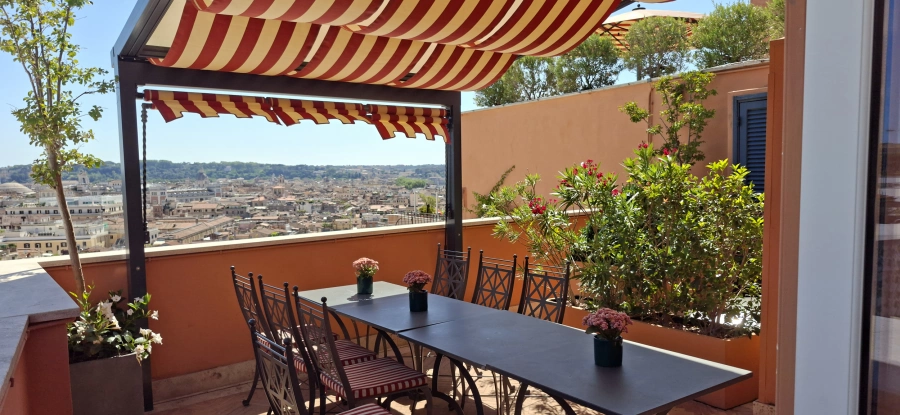
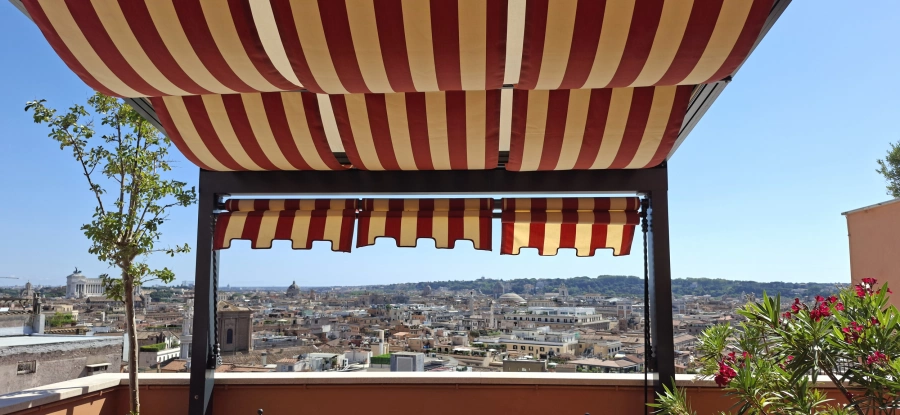
Hotel de la Ville, Rome: striped canopies frame the city's panorama.
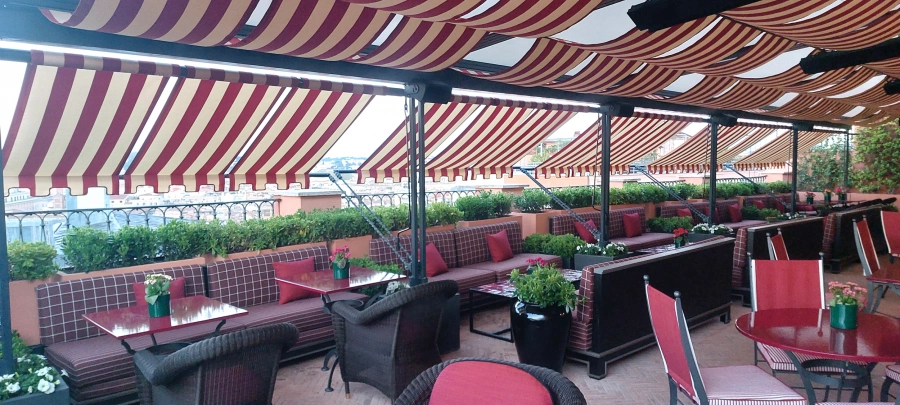
For the project, striped SWELA fabrics were specially ordered in the required red-and-cream colour combination. Particular attention was paid to the width and alternation of the stripes, the way the colours appeared in daylight and their relationship with the terrace surfaces and furnishings. Another essential aspect was the development of the metal shading structures, designed in a classical style. The project incorporated dark metal elements inspired by traditional nineteenth-century structures, with finishes of a rustic character. This approach made it possible to unite the expressive qualities of historical design with contemporary manufacturing techniques and practical performance. ARREDALO took part in the practical realisation of the bespoke solutions, coordinating the custom production of the fabric coverings and structures, together with installation by specialist teams. The result is a collection of shading systems made specifically for the project and harmoniously integrated into the hotel's terraces. Red-and-cream stripes as an architectural elementThe project photographs clearly illustrate how dramatically a striped canopy can transform the perception of a space. When extended, the awnings establish a rhythmic interplay of colour above lounge areas, sofas and café tables. The dark metal structures emphasise their geometry, while the shaped valances reinforce the connection with the traditions of European awning design.
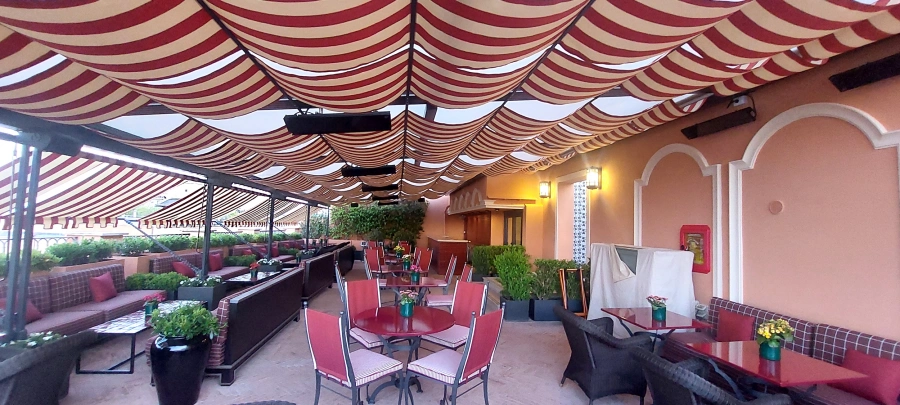
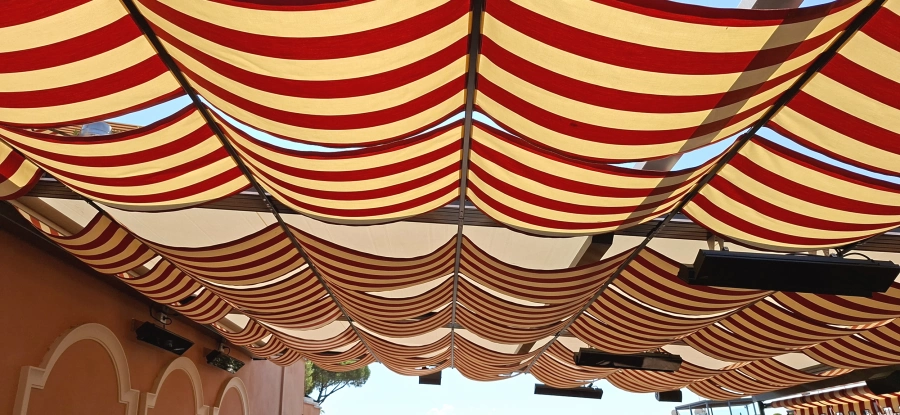
The repeated stripes complement the arrangement of the outdoor lounge areas. On the panoramic terrace, bands of red and cream frame the rooftops and monuments of Rome. Elsewhere, the fabric falls in softer, undulating drapes. The repeated folds create a decorative composition reminiscent of the textile canopies found on historic terraces.
The draped fabric forms an undulating pattern with a striking visual effect. This approach preserves a sense of continuity with historic architecture while employing contemporary materials and sun-protection systems. Importantly, the striped coverings are not merely an incidental decorative addition to this project. They form part of an overarching architectural vision that brings the past and present into dialogue. From nineteenth-century European cafés to contemporary architectureThe history of red-and-white striped awnings shows just how dramatically the meaning of an everyday object can change. What began as practical protection from the sun gradually became architectural decoration, a distinctive commercial sign, a feature of urban culture and, ultimately, an artistic image. We encounter striped fabrics in descriptions of Madrid in the first half of the nineteenth century, engravings of Parisian cafés, Larousse's encyclopaedia, Renoir's paintings and industrial catalogues from the end of the century. Gradually, this expressive motif became part of Europe's shared visual heritage. Today, the red-and-white striped awning is more than a sunshade: it is an instantly recognisable reference to classical architecture, historic cafés and the aesthetics of the Belle Époque. Contemporary designers return to this motif not to copy the past, but to reinterpret its expressive power in new architectural settings. The Hotel de la Ville project in Rome demonstrates how a historical reference can find new life through design, respecting the character of a place while meeting practical requirements. It is where history, architecture, technology and bespoke craftsmanship meet that solutions are created with an appeal that transcends changing fashions. ARREDALO – Bespoke solutions for architecture and professional outdoor spaces. Historical referencesGarden Museum, "It's all in the stripe! The history of the striped garden awning" (2026): Garden Museum. The Phillips Collection, catalogue entry for Renoir's "Luncheon of the Boating Party": The Phillips Collection. National Park Service, "The Use of Awnings on Historic Buildings: Repair, Replacement, and New Design", Preservation Brief 44: National Park Service. * Il nostro blog non rappresenta una testata giornalistica ai sensi della Legge 62/2001 ed è aggiornato senza periodicità. I contenuti sono pubblicati esclusivamente a fini di informazione, critica e recensione. Marchi e immagini appartengono ai rispettivi titolari e sono utilizzati, ove necessario, in forma limitata per citazione/commento ai sensi dell’art. 70 della Legge 22 aprile 1941, n. 633, con indicazione della fonte quando disponibile. I commenti costituiscono un’area di discussione (tipo forum; commenti moderati). Qualora un titolare di diritti ritenga che un contenuto pubblicato sul sito violi diritti d’autore, diritti d’immagine o altri diritti, può segnalarlo indicando l’URL della pagina, il materiale contestato e la prova della titolarità. Provvederemo tempestivamente alla verifica e, ove opportuno, alla rimozione o all’aggiornamento dei credits. |

go to another press releases


|

© Copyright 2010-2026 D’Addazio S.r.l.s. - info@arredalo.com
64011 VIA ROMA - ANGOLO VIA R. MARGHERITA, ALBA ADRIATICA (TE)
P.Iva IT02028150676 - iscriz. alla camera di commercio N° REA TE-173257 PEC: daddazio.srls@pec.it
By continuing to browse this website, you consent to the use of Cookies to facilitate navigation on the site.
For more information and to manage your browser preferences regarding Cookies: read here. Privacy